Ad from the Sheridan newspaper, December 31, 1945.
December 31, 1945, marked the first peacetime New Years in much of the world, although not all of the world was at peace.
1945 marked the end of what we consider the oddly nostalgically recalled, but undeniably bloody, 1940s. It's the operation of Yeoman's Eleventh Law of History, which provides:
1945 was the end of World War Two, and the beginning of the post war era, and era which we still live in. It was the penultimate year of the 1940s, and to some degree, the penultimate year of the long 20th Century.1 It was the year that the Second World War ended with a massive technological nuclear flash, but it was also the year that featured the bloodiest fighting in a unified war that began as a series of wars in 1937 and 1939.
The end of the Second World War determined, or seemed to determine, questions that had arisen with the end of the Great War in 1918. World War One had caused the death of the old order in much of Europe, an order that saw aristocracies dominate in varying degrees in many of the European, and indeed international, states. The strain on the old order was obvious even before World War One, but it remained strong nonetheless. The Great War killed it.
The death of the old order did not answer the question of what would replace it. Every nation that fought in the war, however, would see immediate political evolution due to the war, with all of it reflecting forces that had been at work before the war. In functioning democratic countries with stable governments, that resulted in an expanded franchise. The UK extended the vote to entire classes that had not had it before the war, allowed Ireland to go independent, more or less, allowed its dominions to be actually independent, and extended the vote to women. The US extended the vote to women and soon made Native Americans citizens, with new states being admitted to the union prior to the Second World War. Canada and Australia obtained true political independence.
In countries that had strong aristocracies that opposed democracy, however, radical elements of the far left that had been underground to some degree leaped forward, the prime example being Imperial Russia, which became the Soviet Union. As forces of the far left advanced, finding a great deal of support in in the formerly disenfranchised working class, forces of the far right appealed to the same base and to conservative aristocratic classes, crushing democratic forces in between, as in Germany, where the Nazis gained power. In unstable democracies without long histories of democratic behavior, forces of the left and the right contested for total control, as in France, Italy, Spain, Japan, and Mexico, with democracy faltering in many to some degree, sometimes totally.
World War Two was not, as some like to claim, a continuation of World War One, but rather a violent sorting out of the democratic, anti democratic, and populist forces it had unleashed. Starting in the late 1920s it seemed that the question the world was faced with was whether the future was democratic, fascist or communist. The Second World War determined, at least it seemed, that the world would not be fascist, but left the question of whether it would be communists or democratic undetermined.
Determining the question was bloody on a scale that we can no longer even imagine, although in terms of human history it was not all that long ago. The expenditure of lives in the war by all contestants was enormous, with the fascist and the communists states freely willing to waste the lives of men, and the democratic ones emphasizing technology where they could. All the combatants, however, acclimated themselves to conduct that at least the democratic ones would not have tolerated prior to the war, with mass bombing of urban targets being the most notable. By 1945 the US, arguably the most moralistic of the combatants, was willing to engage in fire bombing and ultimately the atomic bomb to bring the war to a conclusion.
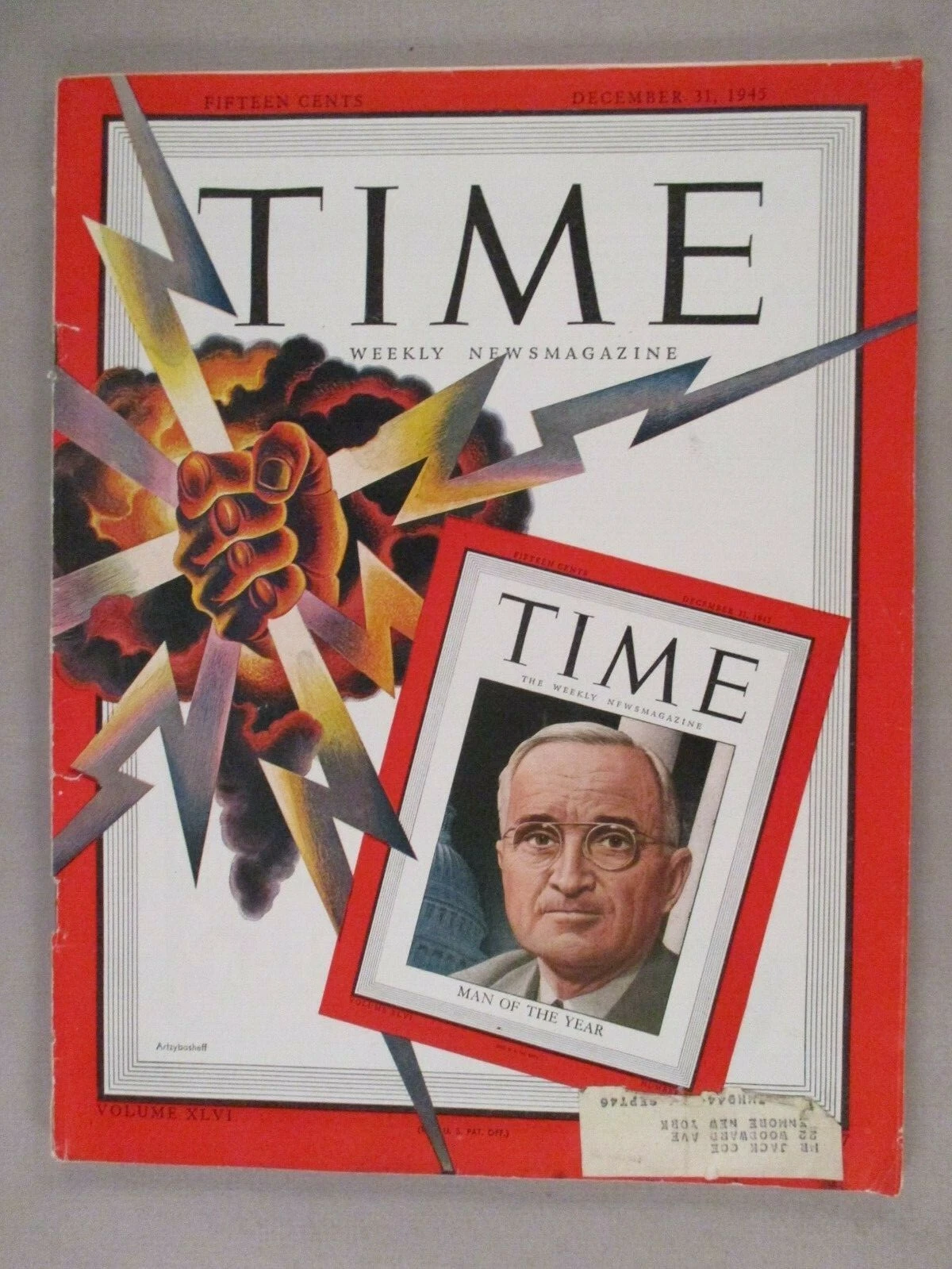
Truman as Time's Man of the Year, posted under fair use exception.
The significance of the atomic age, contrary to the way things are currently remembered, was appreciated immediately. Truman was Time magazine's Man of the Year, pictured in front of a fist grasping nuclear firebolts. Newspapers, even by late 1945, were pondering what atomic warfare would mean.
We've argued it here before, but the Second World War created the modern United States, and more than that, modern American culture, in both good, and bad, ways.
Tire rationing came to an end on this day in 1945.
The most oblivious, at first was the change to the economy, which was little understood. Pent up consumer demand dating back to the start of the Great Depression meant that the country did not slide back into the depression as nearly all Western economist had feared. Adding to this, however, was the fact that none of the European industrial powers, along with Japan, had not suffered some level of industrial destruction. The U.S.'s industrial base was not only left intact, it had expanded. Only Canada could claim to enjoy the same situation, although its economy was much smaller. American workers took advantage of the situation nearly immediately with a wave of strikes demanding higher wages, strikes that were in fact largely successful. The economic golden age that current Republican populists imagine to have existed in the past reached its most pronounced form in the 1950s which is still looked back upon fondly, if inaccurately, in the same way that singer Billy Joel imagined it to have been in his lamet Allentown
Well our fathers fought the Second World War
Spent their weekends on the Jersey Shore
Met our mothers in the USO
Asked them to dance
Danced with them slow
And we're living here in Allentown
The obliteration of European industry created the illusion of some sort of American economic uniqueness that remains to this day and which the country is presently attempting to sort out by restoring it, which will not and cannot work. Part of that also involves an imagined domestic perfection that doesn't' reflect what was going on in reality either.
Prior to the Second World War the domestic culture of the United States was different in nearly every fashion. Even the horrors of World War One had not changes that. Most Americans lived closer to the poverty line than they do today, even if most Americans lived in families. Most Americans did not attend college or university, and most men didn't graduate from high school. There was a minimum of surplus wealth on the part of the average, although that had started to change by imd 1920s, only to be retarded by the Great Depression. Most people did not move far from home. Most men and women married people who grew up near them and were part of the same class and religion, although a surprisingly large lifelong bachelor class existed, particularly in certain occupations.
The war changed nearly all of that, and even during the war itself.
The first peacetime Federal draft in the nation's history took thousands of young men away from their homes starting in 1940 and 41, and of course became the major wartime draft that continued on until after the war, and with some hiatus, basically until 1973. The country would not have tolerated a peacetime draft prior to 1940, and barely did in 1940 and 1941. The country's views on the military, which prior to the war was sort of a type of disdain but acceptance of it as necessary, as long as it was small, completely changed during the war so that by the war's end the concept of a large peacetime military was fully accepted, and even admired, although that would be disrupted again due to the Vietnam War for a time.
Prior to the war, soldiering was, for enlisted men and junior officers, a bachelor occupation with servicemen largely looked down upon as lazy. The enlisted ranks often contained large numbers of immigrants, although that is still true. After the war, the view of servicemen, many of whom for decades were conscripts on relatively short enlistments changed radically.
The expectation of marriage changed as well, even at a time that wartime marriages came into periods of great stress. Prior to the war a fair number of blue collar workers and nearly all non owner agricultural workers were lifelong bachelors.
Cowboys Out Our Way from December 31, 1945. The two working hands are discussing "Sugar", their former ranch cook, who just married a rich widow, and Stiffy, the oldest cowhand on the ranch.
This ended after the war for a variety of reasons, one simple one being that entire classes of men who had never really lived any other life now had seen at least much of the country, and some large sections of the globe. Men who had planned on a life of working on the farm or ranch and living in a bunkhouse no longer found that appealing and no longer believed they had to do that. For those who returned to their states of origin, and huge number of them did not, this often meant taking up a job in towns and cities, rather than in fields. Quite a few used the GI Bill to advance an education that benefited them at a time in which a university education guaranteed a white collar job. Regions that had large reservations found that many returning Native American veterans chose to live in towns and cities near the reservations they were from, rather than on them where living conditions remained comparatively primitive. Lots of men married who would not have otherwise. The average marriage age notably dropped for the first time in decades and remained depressed in the 1950s.
Lots of couples got divorced in fairly quick order as well.
This was because of a "marry in haste" situation that had broken out during the war. Couples who figured that the male's chances of surviving the great blood letting were fairly slim and were willing to accordingly gamble, where as previously they would not have been. Moreover, many of the couples that married were of different backgrounds and different regions of the country, and not the literal "girl next door" so often portrayed. A really good portrayal of the this sort of situation was given in the brilliant 1946 film The Best Years of Their Lives, which gave a dramatic, but fairly accurate, examination of the domestic situation of the post war years. Of note, 1946 also gave the country It's a Wonderful Life, which really portrayed the prewar, not the wartime or postwar, domestic ideal.
The amazing film The Best Years of Our Lives which captured the immediate impact of World War Two on Americans.
It's a Wonderful Life, also released in 1946, but which really portrayed the nature of American life from the 1910s until the late 1930s, although it was set in 1946. It's gone on to be a sentimental Christmas classic.
The Best Years of Their Lives also depicts fairly heavy drinking, and not in an accepting fashion, but in a relatively realistic one .That was also something that the war really brought in. Returning veterans were often very broken men, and alcohol abuse was an enduring feature of their lives, along with chronic cigarette smoking. This bled over into the culture in general and an increased acceptance of heavy alcohol use became common, and indeed is something often featured in post war films in a routine fashion. Men who had endured killing on a mass scale often never really adjusted back to a normal life, and resorted to the bottle in varying degrees.
At least by my observation, some of these men became downright mean. We hate to say that about "The Greatest Generation", but it's an enduring theme of the recollections of many of their children. Alcoholic fathers who were extremely demanding on their male children seems to have been routine. Again, by my observation, many of the same children, who went on to rebel during the 1960s, returned to their childhood roots and became mean demanding fathers to their own children, making World War Two the domestic abuse gift that keeps on giving.
While certainly most returning veterans did not become mean, or abusive, it has to be noted that the Second World War started the country off on a destruction of the natural relationship between men and women we're also still dealing with.
Not since the American Civil War had so many young men been taken away from their homes and never in the country's history had so many young men been kept in the company of young men overseas. War involves the ultimate vice, the killing of other human beings, and all other vices naturally come along with it, in varying degrees by personality, and by military culture.
All wars involve the abuse of women, the most spectacular example during the Second World War being the mass rapes, often accompanied by murder of the victims, by the Red Army late in the Second World War. There are some examples by Western armies as well, but they are much smaller in scale. Also notable, however, was the largescale outbreak of prostitution in Europe, some of which was conducted nearly publicly in places that would never have tolerated it before the war. Economic desperation caused much of it in some areas, which included underaged European women prostituting themselves in some instances and the military simply accepting it.2
Bill Mauldin in 1945. The diminutive Mauldin appeared a little younger than he actually was, being 24 years old at the time of this photograph. Indeed, Mauldin strongly resembled, oddly enough, Rockwell's Will Gillis depiction of an average GI. Mauldin's appearance contributed to a public view of the cartoonist that fit very much in with the public's image of "fresh faced American boys" in general, but he'd already lived a hard life by the time he entered the service. She son of New Mexican farmer/ranchers who were partially native American, Mauldin's early life had been somewhat chaotic and his teenage years were more so, being somewhat on his own by that time and living a somewhat odd life by the time he was in high school. While Mauldin is associated with the typical GI, his status as a member of the staff of two separate Army newspapers lead to an atypical existence including have a teenage Italian mistress when he was in Italy. In some ways Mauldin reflects the best and the worst of Army life in his cartoons and for that matter in actual service life.
Even where not completely sordid, plenty of misconduct occurred in all of the ranks. This is depicted in the recent series Master of the Air with at least one of the affairs depicted actually having occurred. In fictional form, it's portrayed in 1956's The Man In The Gray Flannel Suit.
The Man In the Gray Flannel Suit from 1956, but which starts off in World War Two and the moral failings in combat of the central character, including the violation of his marital vows.
This was bound to have some impact on the wider culture, and we've argued that it lead to the wider acceptance of the objectification of women. Indeed, thousands of men became acclimated to the centerfolds in Yank during the war, making the introduction of Playboy in 1953 not all that much of the big leap as its claimed to be.
Playboy often gets credit for firing the open shots of the disastrous Sexual Revolution, but it can be argued that Yank did. At any rate, by the wars end, millions of men had served in places were morality of all types was at a low ebb, and had ogled the girls in Yank, and perhaps painted topless or nude figures on government aircraft. That this would have some effect, particularly later when bogus sex studies were released as scientific texts, isn't too surprising. The major erosion of the natural order between men and women that came into full fruition after the late 1960s had some roots that went at least as far back as the 1910s, but World War Two gave it a major boost.
The war also gave a major boost to automobiles.
Prior to the war, and during it, the US relied on rail transportation. But new types of automobiles, notably 4x4s, were introduced during the war, and cars overall simply improved. By 1950 it was clear that road building and automobiles had become a major American obsession, spawned in part by the heavy road use, in spite of automobiles, that occurred during the war. 4x4s, which were strictly an industrial vehicle, were introduced into civilian use shortly after the war, with pickup truck variants ending the need for ranches to have cowboys in the high country during the winter, and allowing any part of the country to be accessed to some degree by sportsmen or agriculturalist year around.
1947 Sheridan newspaper advertisement for what was probably a surplus Dodge WC.
Reliance on equine transportation, in contrast, started to decline markedly.
December 31, 1945 brought the news that Hirohito had renounced claims to divinity, with the nature of the Japanese monarchical claim on that point never understood by Westerners in the first place. He did not ever claim to have been a god, and it was soon learned that the majority of the Japanese had never believed in the imperial family's claim to a unique divine status in the first place.
The war ended, seemingly for good, Japanese militarism. It also seems to have ended German militarism as well, something assisted by the fact that the Soviets ended up with Prussia, it's source.
The war, of course, also advanced the frontiers of Soviet domination beyond its 1940 status, something the Soviets had been working on since 1917. This would prove to be temporary, as would the Soviet Union itself, but that could not be foreseen in 1945. A world that had worried about whether fascism, communism, or democracy would prevail, now worried over whether communism or democracy would be the ultimate victors.
In China, where on this day an unsuccessful treaty between the Nationalist and the Communists would be signed, a contest more resembling the pre World War Two one was going on, revived from its 1927 start and temporary hiatus during the Second World War.
1945 was a fateful year. For Americans it started with American troops fighting the Germans in Bulge in Operation Wachts am Rhein and in Alsatia in Operation Nordwind. For the Soviets, January 1945 would be the bloodiest month of the war, as it would be for the Germans. For the Japanese, it marked pitched resistance to Allied advances everywhere, and a desperate effort to advance in China. It all came to an end in August, 1945, and by December 31, 1945, the world was trying to sort out where it was going. Much of it could be anticipated, but much could not be.
The prewar world was gone forever. Sorting that out is still going on.
*I had typed out a very long and detailed look at the 1940s, and 1945, for the December 31, 1945 entry, before some computer glitch entirely wiped it out. It's completely gone.
I may try to reconstruct it a bit, but the fact that I started working on it some time ago is a deterrent to that. And even if I do, a reconstructed post is never as good as the original.
1. Like decades, centuries don't really track the calendar precisely either. The 20th Century arguably began around 1898 or so, and continued on, perhaps, to 1991, when the Soviet Union collapsed.
2. An interesting sympathetic depiction of a woman engaging in prostitution due to economic desperation in found in the 1946 Italian film Paisa'.
Be subordinate to one another out of reverence for Christ.
Wives should be subordinate to their husbands as to the Lord.
For the husband is head of his wife just as Christ is head of the church, he himself the savior of the body.
As the church is subordinate to Christ, so wives should be subordinate to their husbands in everything.
Husbands, love your wives, even as Christ loved the church and handed himself over for hert to sanctify her, cleansing her by the bath of water with the word, that he might present to himself the church in splendor, without spot or wrinkle or any such thing, that she might be holy and without blemish.
So husbands should love their wives as their own bodies. He who loves his wife loves himself.
For no one hates his own flesh but rather nourishes and cherishes it, even as Christ does the church, because we are members of his body.
“For this reason a man shall leave father and mother and be joined to his wife, and the two shall become one flesh.”
This is a great mystery, but I speak in reference to Christ and the church.
In any case, each one of you should love his wife as himself, and the wife should respect her husband.
St. Paul, Ephesians, Chapter 5.
As the old phrase goes, fools rush in where angles fear to tread, and my commenting here is, I am well aware, completely foolish.
I know next to nothing about domestic law, and even less than that. I've never experienced any aspect of it myself personally, I don't delve into it regularly at work, but on odd occasion I, like every lawyer, must.
I don't like it when I have to.
When a civil litigator takes a look at domestic law, he often tends to be shocked. I was that way when I looked into the topic of grandparent's rights some years ago. The opponent was also shocked when I started treating the case like heavy duty civil litigation. What the heck? Well, the case ended up changing that area of the law after years of the domestic practitioners just doing the "well, that's the way we do this".
Not anymore.
Recently I've been looking at divorce law for a tangential reason, and once again I'm shocked and appalled.
Wyoming uses "no fault" divorce, like most states.
Or maybe it doesn't. More on that below.
No fault was the biggest insult to the law ever created and a knife to the gut of society.
Illustration of No-Fault Divorce. The petitioner is taking a blade to the gut of a helpless defendant.
The legislative stupidity in this area, however, started some time before that. As such things often do, the story has a "the road to Hell is paved with good intentions" aspect to it.
Let's go way back.
At least during the state's territorial days, court's would occasionally order a cohabitating couple to marry. This led me to assume that cohabitation of unmarried couples was illegal, and perhaps it was, but I've not found any statutory basis for that. I haven't researched it in depth, either. Fornication was a crime in many states, however, and it might have therefore been one in Wyoming. Additionally, Wyoming imperfectly adopted the Common Law upon statehood, and for that reason court's may have felt they had the authority to address cohabitation, which normally would result in a marriage by fiat (Common Law Marriage). At least right around the time of statehood there was a statute that addressed this topic in the "statutory rape" context, but the fairly shocking provisions of it were that the ages addressed were 10 years of age for a girl, and 14 for a boy. I.e., a 14-year-old boy was expressly prohibited by law from having intercourse with a ten-year-old girl, and would be tried for rape if he did. Apparently the scriveners of the law in the Dakotas, which is where we obtained our first set of statutes, felt differently about very tender ages than we might. Having said that, the bill in the legislature last year which provided:
(a) At the time of marriage the parties shall be at least sixteen (16) years of age except as otherwise provided.
(b) All marriages involving a person under sixteen (16) years of age are prohibited and voidable, unless before contracting the marriage a judge of a court of record in Wyoming approves the marriage and authorizes the county clerk to issue a license therefor.
(c) When either party is a minor, no license shall be granted without the verbal consent, if present, and written consent, if absent, of the father, mother, guardian or person having the care and control of the minor. Written consent shall be proved by the testimony of at least one (1) competent witness.
Surprisingly, this bill was met with opposition. Before that, ages below age 16 were allowed with the Court's consent, and amazingly, there had apparently been a few instances of that occurring over the last decade.
The change, anyhow, was in my view, a good one. Most people would agree.
Up until 1941, Wyoming had a set of "heart balm" statutes providing for common decency, common sense, protection of the common good, and which were fundamentally grounded in the laws of society and nature. In that year, just months before the Japanese would cause the balance of human decency to be to exaggerated towards oblivion, the 1941 Wyoming legislature eliminated them, stating:
The remedies heretofore provided by law for the enforcement of actions based upon alleged alienation of affection, criminal conversation, seduction and breach of contract to marry, having been subjected to grave abuses, causing extreme annoyance, embarrassment, humiliation and pecuniary damage to many persons wholly innocent and free of any wrong-doing, who were merely the victims of circumstances, and such remedies having been exercised by unscrupulous persons for their unjust enrichment, and such remedies having furnished vehicles for the commission or attempted commission of crime and in many cases having resulted in the perpetration of frauds, it is hereby declared as the public policy of the State that the best interests of the people of the State will be served by the abolition of such remedies. Consequently, in the public interest, the necessity for the enactment of this article is hereby declared as a matter of legislative determination.
1941 Wyo. Sess. Laws ch. 36 § 1.
Horse shit.
The thing about the "heart balm" statutes is that they heavily weighted the importance of the male/female relationship in a legal and cautionary way. The causes of action were varied, but all of a similar nature. There was 1) breach of contract to marry (breach of promise), 2) alienation of affection, 3) criminal conservation, and 4) seduction. This mean that there were real consequences for failing to seriously undertake the relationship from the onset, and in failing to take care of it. Rarely noticed on this, the penalties fell more often on men, than women, but protected both.
What were these causes of action?
We'll take a closer look.
The proposal.
Breach of promise.
Breach of contract to marry, or as it was more often called, "breach of promise", was a unilateral broken engagement. The non-breaching party was entitled to receive damages that included the benefits were that were to be had from the marriage and specific injuries to the plaintiff, including humiliation and psychological injury.
In the view of us moderns, this seems Victorian and quaint, but it was anything but. Prior to birth control, relationships between men and women were, we might say, deadly serious. While the social standards, based on Christian concepts and morality, meant that sex before marriage was frowned upon, and while it was also the case that a high percentage of people, particularly women, did not engage in sex before marriage, things began to break down when couples engaged and people knew it. This does not mean to suggest that people behaved like they do now, as they certainly did not.
Engagement periods seem to have lasted a year or so, although there wasn't any set period. One period etiquette book provided:
There are exceptions to the rules which govern engagements, as well as other things; but as in other cases, the exception only proves the wisdom and justice of the rule. There have been happy marriages after a few days' or even hours' acquaintance, and there have been divorces and broken lives after engagements which have existed for years. The medium, therefore, may be considered the best plan to pursue; namely, an engagement which is neither too short nor too long, but just sufficient to make a broad and easy stepping-stone between the old life and the new. The result of a very short engagement depends upon the strength and genuineness of character in the individuals, while the haste with which they have consummated so important a step says but little for their wisdom or prudence. A hasty and ill-advised marriage is a bad beginning in life. A very long engagement, on the contrary, is an eternity of that hope deferred which maketh the heart sick, and it is much harder for the engaged girl than for the engaged young man who is "a laggard in love". She has to wait usually, while he works actively, bringing himself into new relations, obtaining new experiences, and in many ways living a life which she can not share, and which is more than likely to interpose a barrier between their mutual sympathy and confidence, and cause them to drift apart from each other.
Gems of Deportment and Hints of Etiquette, Martha Louise Rayne, Detroit: Tyler & Co., 1881.
There was more to it than that, however. Close contact of this type was going to lead to something with some people. Therefore, with a broken engagement, the female participant would be potentially at least slightly tainted in some fashion, either regarded as "ruined" or regarded as an obviously difficult and unmarriageable person. There was a flip side to this, which we'll address below.
Additionally, in an era in which women had limited career opportunities, getting engaged set a woman on a certain financial course whose sudden end could be devastating economically. It was assumed, naturally enough, that during the engagement she'd sworn off other suitors, many of whom would have moved on in the meantime. Indeed, amongst the very old even now you'll frequently read stories of very elderly "first loves" reuniting, showing that whatever went wrong early on had forced them into other paths, even if they obviously retained affection for each other.
Seduction
The flipside of breach of promise, this tort sounds obvious, but in practice it was less so. The tort allowed an unmarried woman's father - or other person employing her services - to sue for the loss of these services when she became pregnant and could no longer perform them. We recently saw an example of this being played out on the Canadian World War Graphic History blog in an entry concerning Lieutenant Colonel Charles Flick.
As that entry noted, Flick and one Kate O'Sullivan engaged in some sort of sexual act. What occured isn't clear, but it seems pretty clear that Flick seduced Kate, or perhaps raped her. In any event, Flick, then an officer in the British Army, was sued by Kate's father. As the blog notes:
Seem harsh (assuming it wasn't rape)? Well, it really wasn't. Kate, at age 25, was reaching the upper limit of her marriageable age at the time, and now she had a daughter to take care of without Flick. Whether Flick tried to make it right (which was common) by marrying her or not, we don't know They didn't marry, however. Mr. O'Sullivan was left, therefore, with the financial burden of his daughter, who could now no longer work, and his granddaughter as well.
While this may all sound pretty harsh, it reflected an economic reality that still exists. Seduction continues to exist as a legal principle, even if we don't recognize it. It exists in the form of child support laws, which achieve essentially the same thing, but through the partial intervention of the state. At the time, it was up to people to take care of this on their own, which was not a less just system.
Flick, by the way, went on to a career in the British Army, serving overseas, and ultimately in the Canadian Army. He was an opponent of Japanese internment in Canada, so no matter what his early story was, he wasn't entirely a terrible person.
Alienation of Affection.
This occurred when someone interfered with the marriage, causing a spouse to lose affection, mostly often through seduction, but not always. Indeed, meddling third parties could be liable for interfering with a marriage, including objecting in laws or even clergymen. In the Wyoming case of Worth v. Worth, 48 Wyo. 441 (1935) a daughter-in-law suited her in laws on just such a claim, recovering the amount of $35,000 in damages. The damages in such cases were for emotional distress and mental anguish, shame, humiliation, and economic loss, including financial contributions toward the marriage and potentially punitive damages.
The elimination of this tort created a situation in which unrestrained interference in marriages can and frankly does arise. Amongst women, it tends to come up in terms of the "support" of female friends, many of whom have broken relationships themselves, or in some instances feel that a friend married beneath herself. I've seen this happen first hand, with the women who don't have to live the consequences harping on tehir friend to divorce.
The flipside of this is that men do the same thing, but it tends to be over other issues, with those issues often being sexual. In spite of they hypersexualized era in which we live, or perhaps because of it, it's frequently the case that couples enter a marriage badly damaged in this area and ultimately that impacts the woman much more. Women with multiple sexual partners before marriage are almost statistically incapable of living out their marriage. Women who have abused, on the other hand, tend to withdraw from the "marital debt" at some point leaving their husband's stunned. In that case, the men will tend to get the advice from their fellows that they should dump their wives for a more willing, and often younger, partner, or they'll simply begin to engage in adultery and excuse their conduct.
Criminal Conversation
Criminal conversation was similar to Alienation of Affection, but involved sex, so the last item noted here had arisen.. It was the tort of sexual intercourse outside marriage between the spouse and a third party, with each act being a separate tort, and the liable party being the third party. Damages included emotional harm, mental suffering, loss of support and income, and loss of consortium.
Not surprisingly, this tort changed over time to something radically different, and it then allowed an unmarried woman to sue on the grounds of seduction to obtain damages from her seducer, if her consent to sex was based upon his misrepresentation.
The unifying thread in all of these is that they took marriage, and beyond that, the male female relationship extremely seriously. For want of a better way to put, they took sex very seriously as well.
One of the things that the Sexual Revolution proved was that people were incredibly naive about sex, but not in the way that the revolutionaries imagined. In fact, the pre revolutionary condition proved to be the wise one, as it grasped the nature of sex. While perhaps not the best way to set it out, we'll quote here an item from Quora, which is always a somewhat dubious source of anything, which was on a thread on whether premarital relations should be illegal, which in a few countries they still are. Some commentator noted:
Sex absolutely, deeply and irreversibly transforms
You
Physically, Emotionally, Mentally and Spiritually.
It transforms abusers and the abused,
It transforms actors in porn,
It transforms friends who do it casually,
It transforms one-night standers,
It transforms johns and the prostitutes,
It transforms gays and lesbians,
It transforms the masturbater,
It transforms viewers of porn,
It transforms people who only do it orally,
It transforms those who use protection,
It tranforms unmarried couples,
It transforms married couples,
Sex is a language of the body.
And it is a langualge that has a definitely fixed meaning.
It communicates an absolute message.
It says I AM YOURS, FREELY, COMPLETELY, FAITHFULLY and FRUITFULLY.
After sex, you will either be made or ruined
Physically, Emotionally, Mentally and Spiritually.
We can think that nothing in us has changed,
But we will never the same as before.
We can tell ourselves that sex is pleasurable and healthy exercise,
And that we will be worse off denying ourselves from the pleasure it gives.
But, we will still have trivialised the message our body has communicated.
When we add meanings to the fixed message of sex,
The message of our mind is not aligned with the fixed message of our body.
We are no longer integrated. We have lied.
Sex in forms that detract from its fixed message is an abuse of the body.
It is cripplingly addictive, simply untruthful, absolutely unfulfilling and very ruinous.
If you have not done it. Don’t begin.
If you have done it, learn from this and do your best to cease.
Be hopeful. Every Saint has a past. Every sinner has a future.
Remember, the purpose of sex can only be properly fulfilled within and after
Marriage.
Written almost like a poem, the writer is absolutely correct. Psychologically, biologically and chemically, sex changes everything. It binds the people, whether they wish to be or not.
Indeed, in the area of odds and ends, one of the commentators on Catholic Stuff You Should know once noted this in that he was with a group of friends who wished that he could still see women the way he had, before. He remembered having done that, but the change was too profound to allow him to do again. That's likely nearly universally true, at least for men.
On a scarier note, in an interview I heard some time ago from a very orthodox Catholic source, a person who assisted with exorcisms noted that in some cases the possession had come about during intercourse, the metaphysical nature of it being such that license existed due to the marital act for the possession to transfer from one person to another.
Now, people like to wink and note that even amongst members of Apostolic faiths, premarital sex is common. But prior to birth control, it was much less so. It was not, however, nonexistent. Part of the breach of promise recognized this. But part also recognized that once couples head down this road, there's no real coming back, ever.
Ever.
And that, in no small part, is why "no fault" divorce works an irreparable and unconscionable injury to marriage, the married, and men and women in general.
It should not be allowed.
Before we look at that, or rather before we carry on directly, however, we'll take a big diversion. The reason is that we happened, in an unrelated fashion, upon something tagentially related to this topic and started a post on it, but then decided that it would really be better set out here.
And that involves two videos from The Catholic Gentleman blog.
Normally I'd be very hesitant to post a video of this type, probably out of cowardice as much as anything else, but these are so well done, if not really titled correctly, I'm making an exception.
They're really insightful.
Having said that, I'll retreat into cowardice a bit. The mere title, "What women don't understand about men", can raise hackles and eye rolls. And the fact that it's linked in from something called "The Catholic Gentleman" will immediately provoke cries of "rad trads" and patriarchist, and the like.
Well, actually, this is much more in the nature of informed evolutionary biology.
And, to note it again, they're mistitled. That's because these two videos could just as easily be "What men don't understand about women, and what women don't understand about men, and why that's the case.
Now, these do take this topic on from a semi religious prospective, but only semi, which is really interesting in that this is from The Catholic Gentleman blog. They creep right up on, and even cross deeply into, evolutionary biology, again in really insightful ways, and frankly if the religious aspects of these videos were omitted, they'd still be highly valid. In the first one, in fact, the religious elements are hardly mentioned.
Now, a few warnings about these insightful videos.
About half of the first one is about sex, sort of, but not completely. Rather, it's more accurately on how men perceives their relationship on a primary basis, which is heavily based on sex, which is part of the reason that they're so insightful. It also means that they touch on a topic gently, but much more graphically, than has ever been discussed here before.
Crud? Yes, but more accurate in some ways than we care to imagine once certain lines are crossed.
But the times call for it.
Put simply, and grossly simplifying it, we're an animal whose evolutionary biology is really odd, and that's not a societal thing. Of all the mammals, we belong to the group that has the highest degree of sexual dimorphism. And of every animal in our group, the primate, we're at the top of the scale, indeed, over the scale, on it. It defines a lot of who and what we are as an animal, and how the two sexes react with each other.
This is not, I'd note, unique to this analysis. The first time I recall reading this was actually a discussion on Homo sapiens evolution in The National Geographic decades ago. The thesis to explain it is that in one of our homo ancestors, quite a few ancestors ago, the dimorphism began when the species intelligence advanced, resulting in an unusually long period before we're mature adults. That meant that our mothers, or rather their mothers, had the responsibility of dealing with and taking care of the infant and child human for a long time. . . years in fact. That caused the dimorphism. Females evolved accordingly in one direction, and that direction emphasized security and relationships. Males evolved in another, and those involved a set of things we have otherwise discussed here, but also, and we really haven't discussed hit here, sex. The National Geographic author's assertion, and it seems well-supported, is that the evolutionary trade-off is that human males became basically ready, if you will, all the time and traded intercourse with human females, who are receptive, unusually, in varying degrees all the time. Females received food and protection.
That is, we'd note, a gross over simplification, somewhat.
As we're a very complicated species, with our big brains, it became more involved than that, but the basic elements remained. Humans do look for lifetime mates. Males are highly oriented towards connecting love of their mate, ultimately, with intercourse, and if it's absent, severe problems typically begin to arise. Women place little importance on that, however, past the initial stage of the formation of the couple, and instead place an enormous focus on relationships and feeling safe. Women really don't understand that for a married couple, or perhaps we should say one in a real union, that for the male, if the physical aspect of it is absent, he'll feel frustrated, insecure, and unloved. Men really don't get that women can simply omit this to some degree, or even entirely, and not feel the same way at all. On the other hand, men don't grasp that if a woman feels insecure, it's relationship threatening.
The first video does a really good job of explaining that. If you want to look into it, and do to my autodidactic nature I did, you can actually find a pile of stuff supporting what they're saying.
The second part of the first installment is on how men yearn for respect and equate love with respect. Women do not. Women expect support. You can find lots of stuff on this as well, although you need to be careful. One thing that is mentioned barely here, but which showed up in a net search, is that a female insulting a male, well, in a physical fashion in this arena can actually be devastating. There's an entire Reddit thread where a married man mentions this occurring in an argument which seems to have largely resolved on its primary point, but which seemed overwhelmingly likely to result in a divorce, even though the woman had repeatedly apologized. Even other women were counselling, "dump her".
A couple of notes, before moving on, one that's touched on in the video, and another not. The video makes a really good point, which has to do with male adolescence and how males develop. The context of it is in regard to transgenderism, and the point is made that the sort of crisis that males go through at a certain age, as things turn on, would be wholly absent for those claiming to be transgendered. Without that, however, you really aren't male. And no doubt the reverse would be true for whatever it is that women go through.
Men Did Greater Things When It Was Harder To See Boobs
Not nearly as touched on, but a major problem, is that not only are men highly oriented in this direction, but at the point at which its realized its like flipping a switch that men can't get back from. This is mentioned in the excellent podcast Catholic Stuff You Should Know. Men really can't' get back from where they started off, once they go down this path (and yes, I'm not going to fill it all in). It's sometime wondered "how" Catholic Priests can endure their celibacy, and it should be noted that St. Paul advised that unless the person had the grace and call to do it, they shouldn't attempt it. Most Priest who are truly called not only have that calling and grace, but they've likely never gotten to the point where the breaker was switched. Once it is, enduring the celibacy would be difficult in the extreme, and we note that in fact not all have endured it.
The second video is on three different topics.
The first is how men handle insecurity and stress, which often is very aggressive, or at least some form of aggression. The other way tends to be through addictive behavior.
The prior set of statues took the relationship so seriously that it was somewhat difficult to contract in the first place, had very serious implications from day one, and was very difficult to break. By being difficult to break, it protected first children, but then it protected the married men and women themselves.
This is not to say that all marriages were always rosy, but truth be known, the majority of marriages that break up do so due to transitory matters. That's why divorce originally required proof of something serious. Critics of the old statutes claimed that this forced people, and they usually mean "women" by people, to make up lies to obtain a divorce, and lying did indeed occur. Missed in that is that the fact that lying was occurring mean that what was being claimed, such as mental cruelty, didn't really exist. It was all just a matter of feelings.
That it is a matter of transitory feelings is borne out by the evidence. At a bare minimum, it's reported that 27% of women and 32% of men regret their divorces, or are willing to admit that they do. Given the nature of such reporting, we can probably easily assume that the real percentages approach at least 40%, if not higher.
Taken out of that, of course, are the percentages of those who divorce who simply kill themselves. Suicide being a risk due to divorce is very well established, although statistics associated with the percentage that take this tragic route are hard to come by, with men being nine times more likely to kill themselves following or during a divorce than women. That last statistic is particularly interesting, as there's something about men that causes them to take that approach at a much higher rate than women, although suicide is an increased risk for men and women due to divorce. Men, it is well known, tend to lose their social structure upon marrying, and it tends to devolve, over time, down to their wife. Again, looking back to old wisdom, the Old Testament informs:
Therefore a man shall leave his father and his mother and hold fast to his wife, and they shall become one flesh.
They do indeed, and this does indeed become the case. It's really easy to find examples of a wife's family essentially becoming the family of her husband, but it's much less common the other way around, in spite of what many people assume. Men getting divorced tend to lose their entire families as a result, their wife, their children, and their wife's family, with nowhere to go. The failure is so existential, they'd simply rather die. Women suffer to, but the classic "going back to her parents" is an option for them. Men don't "go back to their parents". They go back to new dwellings alone.
Suicide is now so common with divorce that its frequently discussed in various divorce related circles, including legal ones. Interestingly, the tragedy frequently is followed by the comment that if a person is edging towards this during the divorce in an open way, it should basically be disregarded, as that's manipulative. At some level, that's an incredibly self-interested set of views. Self-slaughter if never the right answer, and from a Christian prospective, it's a mortal sin. But the people who state "I feel guilty because my spouse killed himself" often really should feel just that. They abandoned their vows and the other person fell into despair, so yes, you should feel guilty, and moreover, you in particularly should not "move on" into another relationship having helped kill, quite literally, your prior one.
All of this is also why the death rate associated with men is also falsely low. Some go home and kill themselves sooner or later, but some simply drink themselves to death, or purposely engage in a lifestyle that will shorten their lives. Some just die, broken-hearted. Indeed, a bona fide medical condition, takotsubo cardiomyopathy, or “broken heart syndrome,” occurs in a certain percentage of otherwise healthy people, killing 5% o those who obtain it, and causing long term health effects for 20% of those who aren't killed by it but survive. In extreme cases, a related psychological condition results in a mental collapse in which a healthy person just gives up the will to live and ceases all efforts to do so, resulting in death coming within the span of a week unless people catch it and intervene.
Oh well, right? We've moved on to the brave new legal world where the facts are made up and the answers don't matter, and just have to live with it.
No we don't. There are things that can, and should, be done. But what can be done?
Be honest about the relationship between men and women.
It's ironic that in the age of freely available information, and great advances in society, that what people have learned is the mechanics of sex, but nothing about its existential nature. This is a root part of the problem.
And I'm using the term "sex" advisably, not "marriage".
If the defenders of Catholic annulments are to be credited, the reason that so many are granted is that people just don't grasp the nature of what they're getting into. As noted above, I'm pretty skeptical on that, but there's at least something to that. Women don't seem to realize that once they become sexually active with a man he can't go back to the status quo ante. They also, in many instances, don't realize (and again, Reddit is full of this stuff) that once the vows are exchanged and the presents opened, they can't really expect a return to the days of care and cuddling. For that matter, once children are born they're not getting back there either. They will have achieved exactly what the New Testament provides, literally:
That is why a man leaves his father and mother and clings to his wife, and the two of them become one body.
He's not going to get over the "clinging".
If the authors of The Catholic Gentlemen are correct, women need to grasp this. But there's a lot that men need to grasp as well. And before we depart on this topic, we'll note, at least in undamaged women, and a lot are damaged, the psychological union that this creates exists too.
When I was looking up stuff for this post, one of the things I just ran across was a post by a woman who had initiated a divorce. Still convinced that she was correct in doing so, she was baffled by why she was repeatedly thrown into lamenting the divorce and the loss of her husband. Of course, the Redditors came in with all sorts of "grieving" statement, and in a way they were right. But the reality of it is that she tried to cut something down that was within herself and killed it so it didn't die a natural death. As that attempt at murder, and indeed it’s a type of self-murder given the nature of marriage, is ineffective, her DNA was telling her what society could not. Her divorce is false. She wasn't the person she was before she attempted to divorce.
It's here where the videos linked in can do a real service. Societally, we lie about sex all the time and have damaged people enormously as a result. What we've essentially done is to encourage people to get on the perversion and decay train, and a lot have boarded it. Then we're surprised by the result. To give an odd example, everyone was surprised when "America's Dad" Bill Cosby turned out to be a serial sexual pervert. But why? We knew that he hung out at the Playboy Mansion and everything associated with Playboy ended in perversion, long term.
This obviously goes beyond marriage, of course, and gets towards being honest about our psychology as a species, which we aren't. We can pretend that the old standards went away, but the old DNA is still there.
What can be done under the current law
Part of the reason, indeed a lot of the reason, things have gotten so bad is that divorce lawyers, have failed to really examine the law much, with rare exceptions.
They should.
Quite frankly, it'll probably take conventional civil litigators to do it.
But what can be done?
Domestic lawyers really don't look at the law much. They have just gotten used to "this is how things are done". An example of that is Wyoming's "no fault" divorce statute, which isn't really no fault. The Wyoming Supreme Court required proof on irreconcilability in a case for the first time this past year, which means it took somebody fifty years to wake up to the fact that the law requires the proof, although the case was very unique, however.
Going back to the old law
We remind people of this:
People constantly imagine that when a mistake is made, and absolting hte old law here was a mistake, you "can't go back".
Of course you can go back.
There actually is a movemen in the nation to move away from no fault divorce. But to get back to the old law society will have to go a bit further back indeed.
It should.
Divorce laws requiring fault should be reestablished, and the "heart balm" statutes brought back. It's those latter causes of action that, as far as I'm aware, which nobody has preposed to restore.
They should.
A societal reaction.
Finally, in order to really take this on, there needs to be a societal reaction, and this makes people very uncomfortable.
Very uncomfortable.
Part of the reason that we have so much divorce in our society is that we've allowed the conditions creating it. We've badly damaged the psychological makeup of our society over a seventy year period by losing what we knew about sex and the relationship between men and women. That's hard to come back from, but it needs to occur. It'll have to start occurring on an individual basis.
Even when I was a college student in the 80's it was still the case that people living together without being married was frowned upon, even if it was no longer really societally prohibited. Doing that on a non-married basis toys with the programmed in nature of sex and the relationship between the sexes in a major way. Indeed, in many societies earlier on, to do that was simply to create a married relationship that the couple was then stuck with. Even in early Christianity, as is so often forgotten, there was no marriage ceremony early on. The couple simply agreed to be married and moved in with each other.
Couples that "live together", as its now politely called, are creating a proto marriage whether they wish to or not, at least within themselves. If this is not going to be frowned upon, it ought to at least be acknowledged for what it really does.
Beyond that, and it would have to start there, the easy separations that have come into being should not be so easily tolerated. Couples break up and divorce, as we know, but it really doesn't have to be accepted by a party that didn't wish to, and if they didn't wish to, they should stand their ground in their status. And this is true, in my view, of religions annulments as well. To go against these, in Catholic terms, is regarded as absolutely shocking and subject the person who does it to attack. Well, proclaiming that you view the other party as engaging in a fraud won't make a person popular, but standing for what is true often doesn't.1
Footnotes:
While I'm aware that it will be a very unpopular thing to say, another aspect of this would be not to tolerate the divorce industry.
Like almost everything that plagues our society, there's a strong industrial element to all of this. The corruption of marriage in the first place, by which we mean the corruption of the relationship between men and women, was brought about in no small part due the pornography industry, which is a subset of the sex trade industry. As it took root, the entertainment industry, the medical industry and the legal industry became highly involved with it.
Law in American society has become an industry, and as noted, it's very tied up in it. Law, like medicine, was a profession, but the corrupting influence of money has very much corrupted it. Divorce litigation is its own industry. There's no reason to respect it, or those involved in it, including lawyers involved in it.